| |
|
 | |
| MaltaWildPlants.com by Stephen Mifsud |
|
| |
|
|
 |  |  |  |
| External Links: |
|
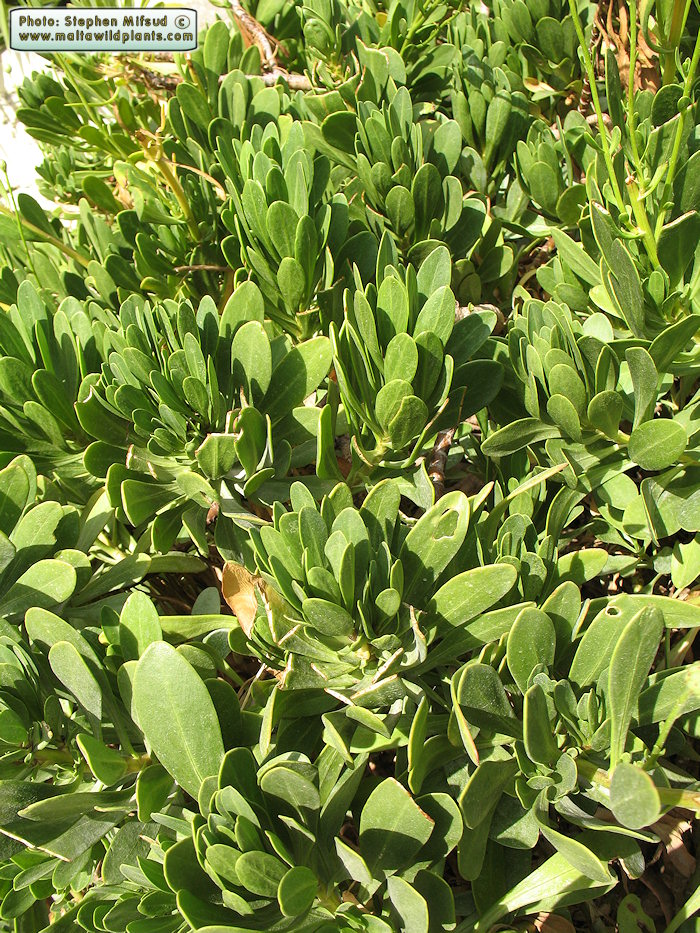
Cheirolophus crassifolius (Maltese Rock-Centaury) |
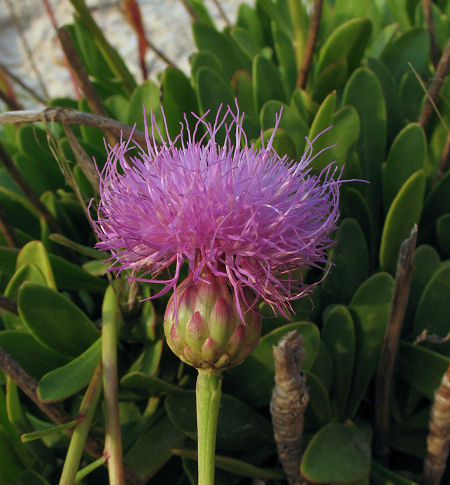
Cheirolophus crassifolius (ASTERACEAE.)
Images for this profile are taken from the Maltese Islands after year 2000. |
|
| Nomenclature and Basic Information |
Species name : |
Cheirolophus crassifolius(Bertol.) Susanna
Published in Bot. Jour. Linn. Soc. 71: 192 (1976) |
Synonyms :
(basionym or principal syn.) |
|
Plant Family : |
Asteraceae
Bercht. & J.Presl (=Compositae) (The Daisy or Sunflower Family)
123 species from the Asteraceae family are recorded from the Maltese Islands. | English name(s) : | Maltese Rock-Centaury, Malta Knapweed |
Maltese name(s) : |
Widnet il-baħar |
Status for Malta : |
Endemic_n |
Frequency : |
Very Common Common Frequent Scarce Rare Very rare Extinct |
Growth form : |
Raunkiaer lifeform [info]: HEMICRYPTOPHYTE ( prostate plants with flowers close to the ground )
Germination [info]: Dicotyledon |
Legal Protection : |
Protected by law: Regulation 26 and Schedule III of [S.L. 549.44] (Strictly protected endemic species) |
Red List (1989) : |
Threatened status for the Maltese Islands and has been listed in the Red Data Book (1st ed.) |
Flowering Time : |
May – July |
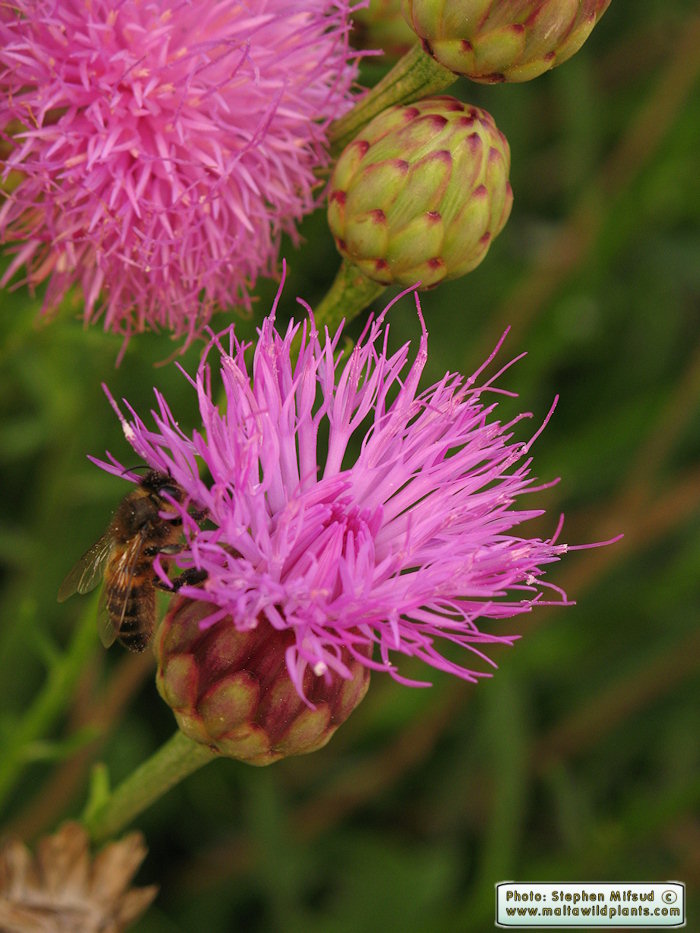
Colour of Flowers: |
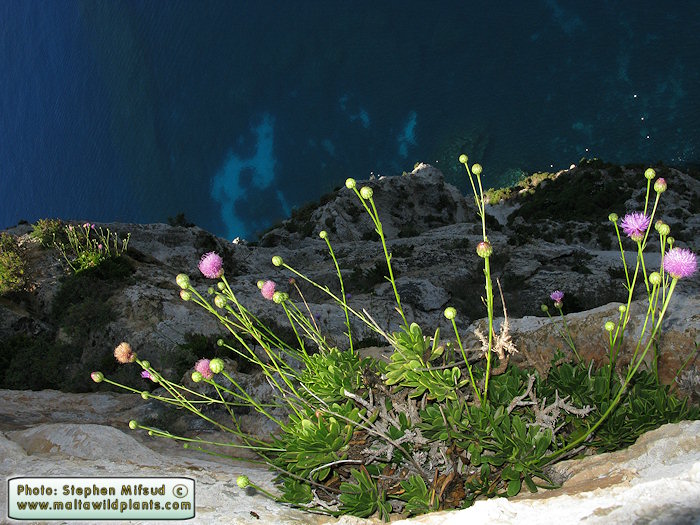
Violet |
Toxicity: |
Not particularly toxic |
Name Derivation : |
Cheirolophus: "One source gives 'Cheiri' as red-flowered, while another says 'Cheir' means a hand. The term 'lophus' means a crest of tufts. The most logical explanation would be that the name means a ""crested red flowers"" referring to the red-purple flowers with a crest-like tufts.". (Greek origin )
crassifolius: Derived from 'crassi' = thick and 'folius' = leaf, hence thick-leafed. (Latin origin )
|
Planting in rural areas : |
Encouraged to be planted in the wild that is in rural areas including ODZ. |
Remarks : |
This species is the National Plant of Malta. |
|
|
Description, Habitat and Distribution | |
Habitat in Europe: |
Maritime cliffs | |
Preferred habitat in Malta: |
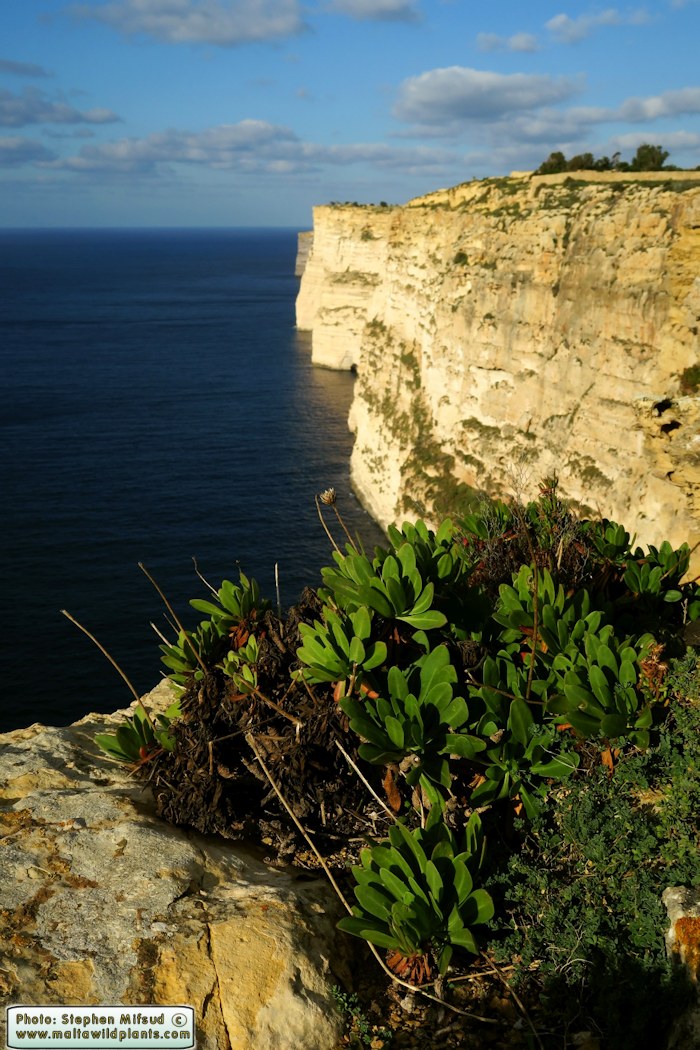
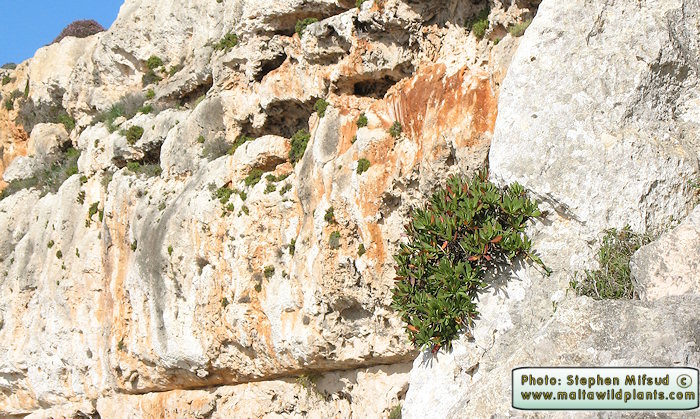
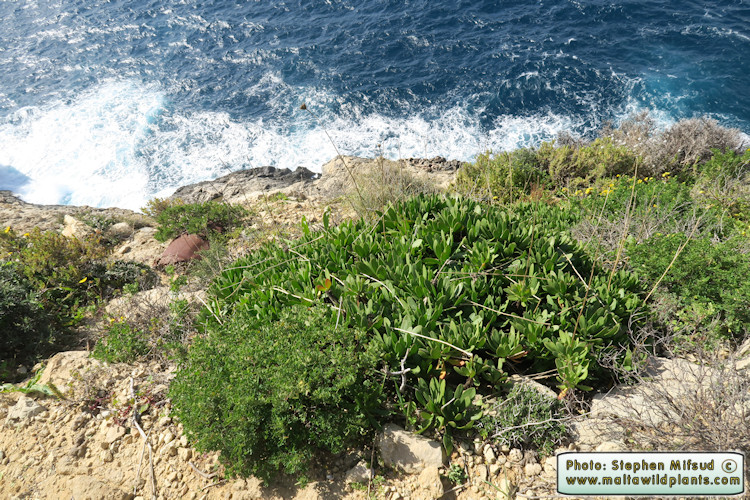
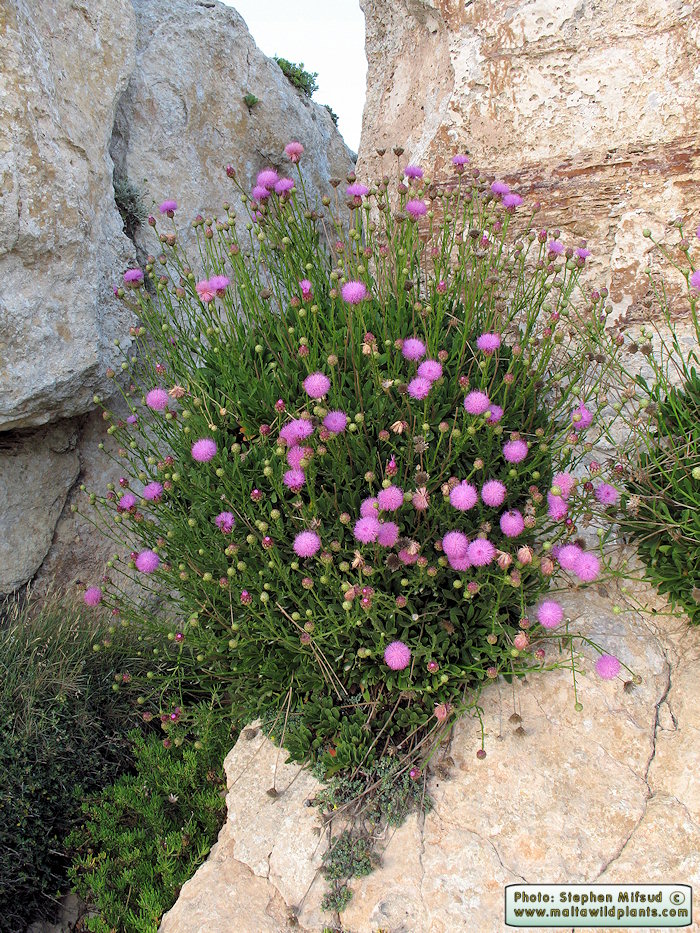
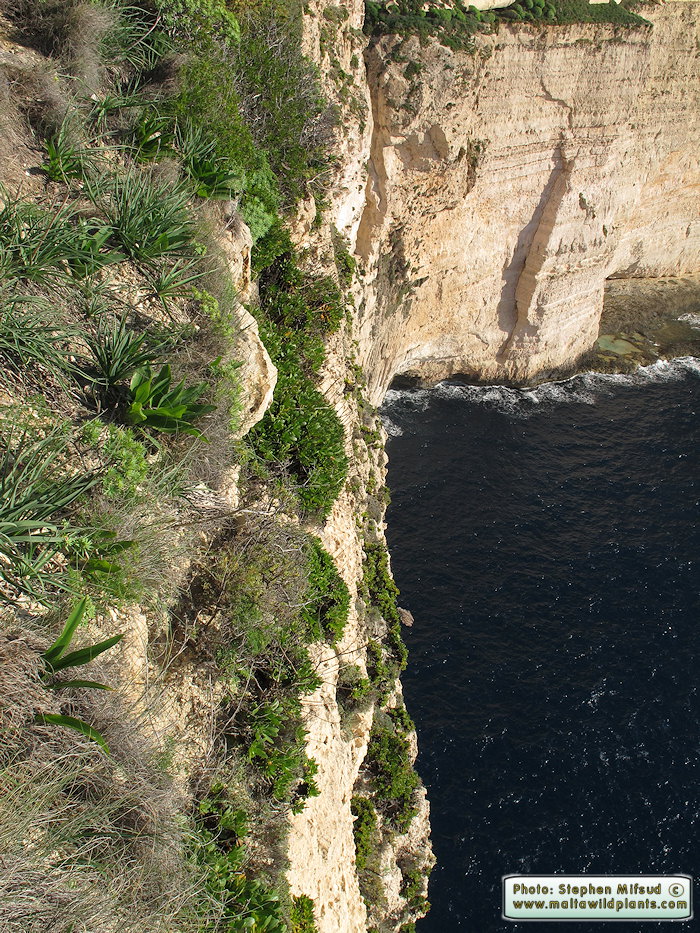
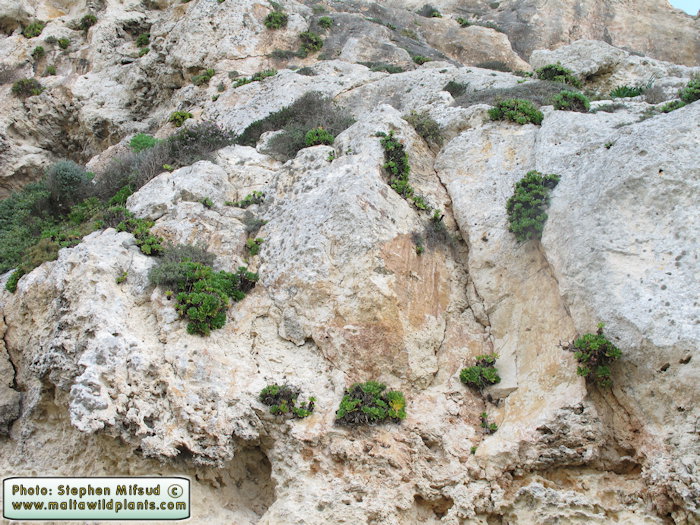
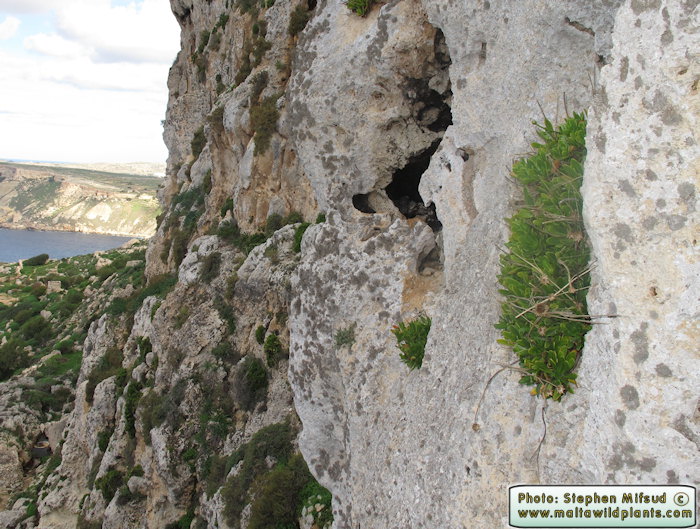
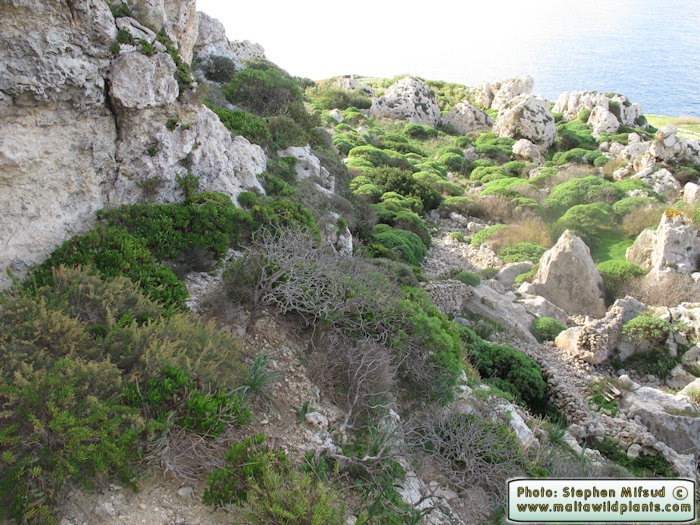
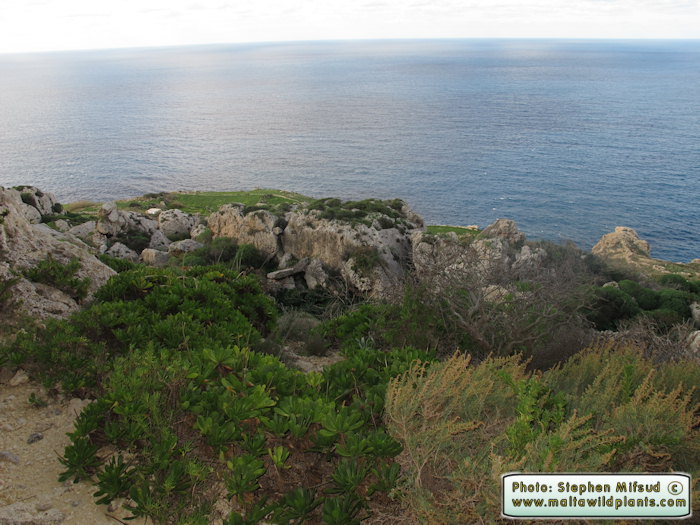
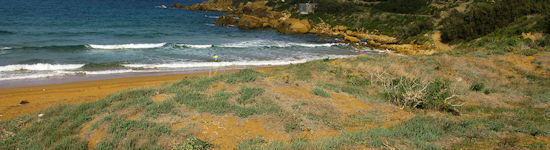
Coralline limestone cliffs and elevated valley sides. | |
Botanical Description: |
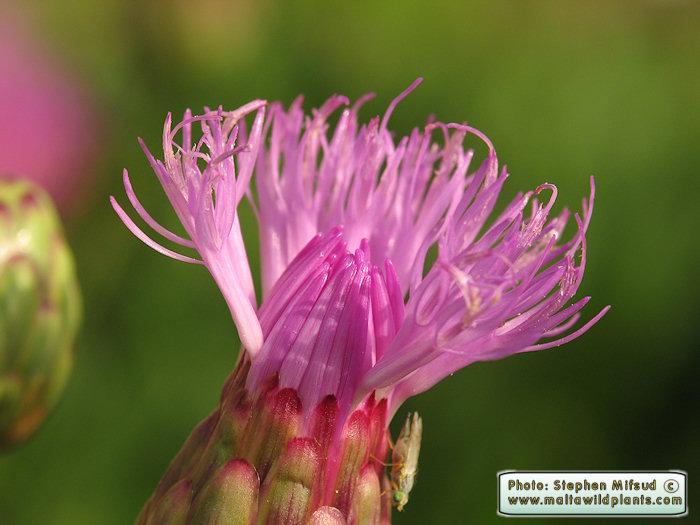
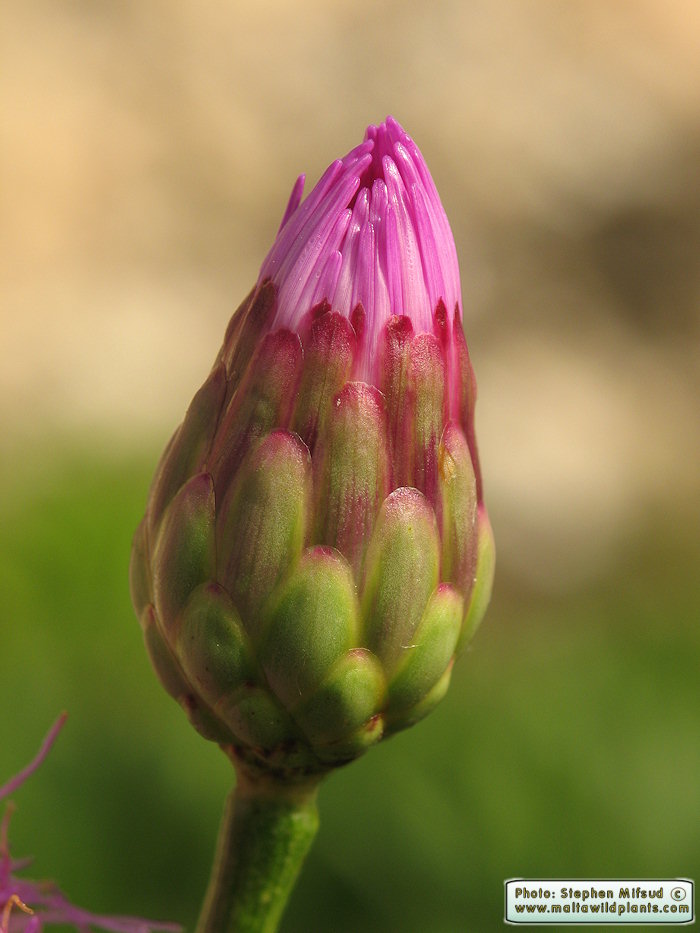
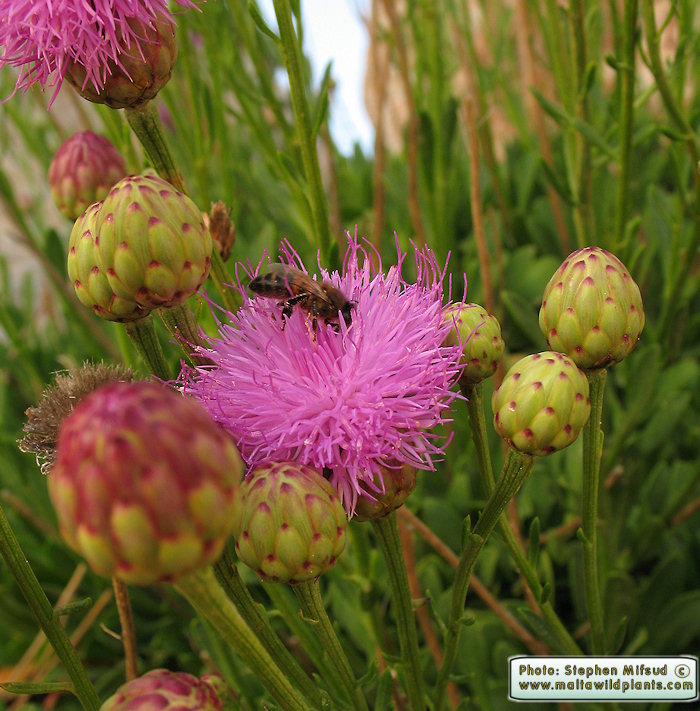
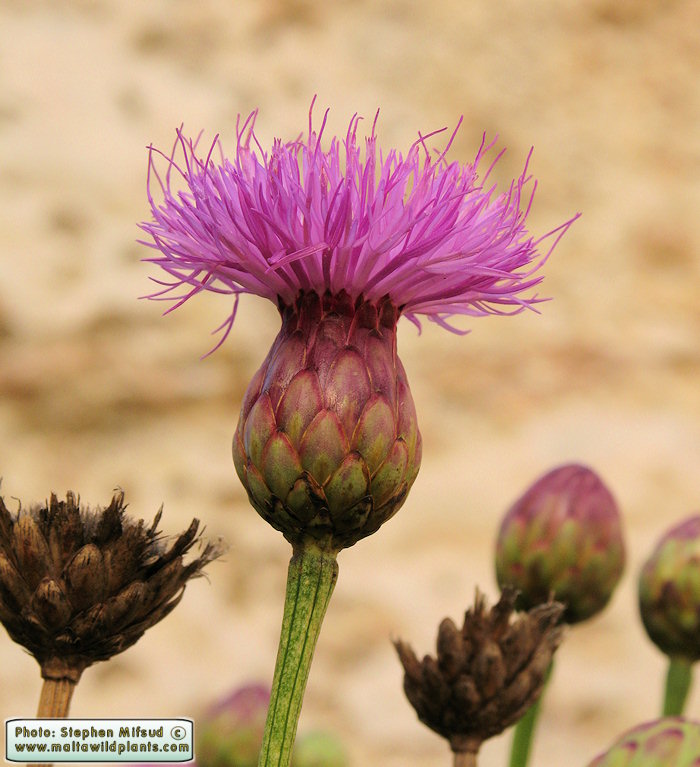
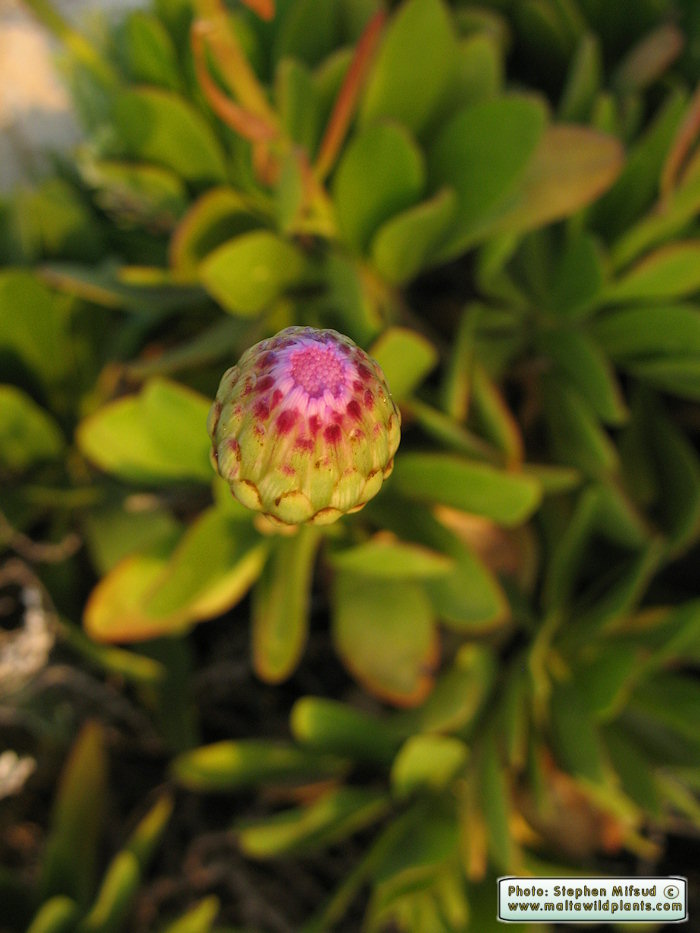
Erect, perennial, glabrous herb. Stem up to 50 cm, branched above. Leaves undivided, up to 6 x 1.5 cm, almost all in a basal rosette, oblanceolate-spathulate, fleshy. Capitula terminal, long-pedunculate, ovoid. Involucre 20-25 mm in diameter; bracts coriaceous with entire margin and without appendage; middle bracts ovate, obtuse, finely striate. Florets all tubular, purple or white. Anthers with acuminate apical appendage. Achenes 6-8 mm, glabrous. Pappus white, slightly longer than the achene, with 2 rows of equal, scabrid setae, the inner row scale-like. | |
Chromosome number: |
2n=30 | |
Distributional range: |
Malta and Gozo. |
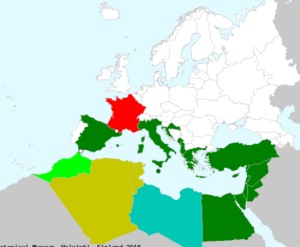
Distributional map in Europe
and the Mediterranean region (2018): |
|
Occurrences in Europe.
(from Flora Europaea pre year 1993): |
Sicily and/or Malta |
Occurrences in Europe and the Mediterranean region.
(from Euro+Med Checklist, 2019)
Country codes
|
? Si(M) |
|
| Links & Further literature
(3 papers) |

Google Web |

Google Images |

Google Scholar |

Research Gate |

Wikipedia |

JSTOR |
GBIF |

Med Checklist |
Cat. of Life |

EoL |

IPNI |

World Flora Online |
Plants of the World Online |

Vienna Virt. Herb. |
RBGE Herbarium |
KEW Herbarium |
MNHN |

Arkive |

IUCN |

CABI |
 |
Assessment of Cheirolophus crassifolius for IUCN Redlist |
Darrin Stevens & Edwin lanfranco (2006) |
| |
Distribution of some rare or endemic chasmophytic and rupestral species growing along the coastal cliffs of the Maltese Islands |
Stephen Mifsud (2013) |
| |
Cytogenetic insights into an oceanic island radiation: The dramatic evolution of pre-existing traits in Cheirolophus (Asteraceae: Cardueae: Centaureinae) |
Oriane Hidalgo, Daniel Vitales, Joan Valles, Teresa Garnatje, Sonja Siljak-Yakovlev, Ilia J. Leitch & Jaume Pellicer (2017) |
Kindly Email if there are papers and publications about local
studies or information about this species to be included in the list above.
|
|
|
| $int_menu2[8] |
|
Use this form to submit more information on this species or report mistakes in this webpage. If information supplied is taken from a book, journal or website, please provide the corresponding reference or website address. Your email address is only for internal communication. Please report only Maltese locations for plants that indicated as rare or very rare (refer to the nomenclature section above). Please do report mistakes, broken links, technical errors, typing / grammar errors, misidentifications or taxonomical updates; this will help to improve the website's accuracy. Thanks you! Fill any of the three sections (A/B/C) below and kindly submit the form. * = required fields.
|
|
|
|
| | |







 Atlas Flora Europaea
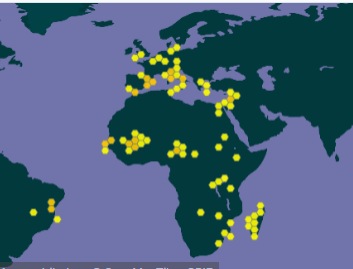 GBIF Distribution map